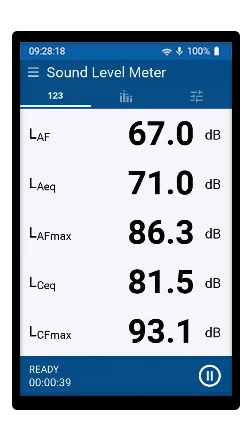
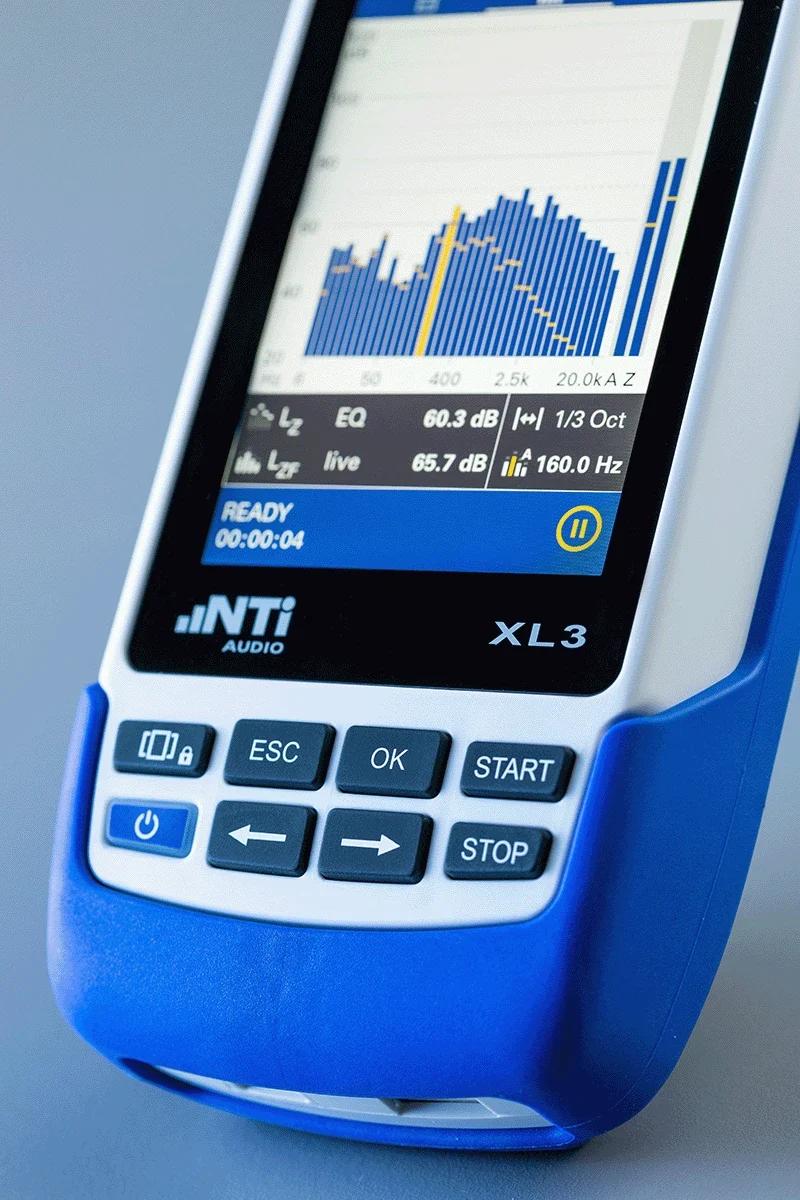
A sound level meter is used for acoustic measurements. The word “acoustic” means “sound that travels through air”. This is opposed to the word “audio”, a term that is also often used in the field of sound measurement. “Audio” refers to sound that travels electronically through cables and audio components. That having being said, let’s get back to acoustic measurements.
A sound level meter needs a microphone to measure the changes in air pressure produced by the sound source. The better quality the microphone, the more accurate the measurements will be. Such measurement microphones are categorized as Class 1 or Class 2. For many applications a Class 2 microphone, which is slightly less accurate and less pricey than a Class 1 microphone, is more than sufficient. Class 1 microphones are usually only required when the law prescribes. Whichever microphone you use, it is important for accuracy that the microphone is correctly calibrated.
The single value measured by a sound level meter is referred to as the “broadband value” as it uses all values across the audio frequency bands (20 Hz to 20 kHz) to calculate the level. It is typically measured in decibels (dB), which is a logarithmic unit. This means, for example, that doubling the sound level would correspond to a 10 dB higher measurement value.
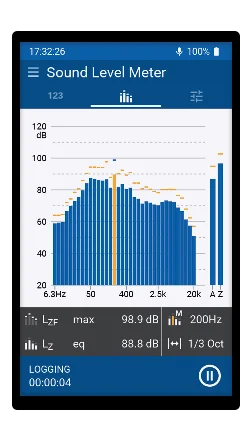
Real Time Analyzer RTA
The spectrum of frequencies provided by an RTA measurement suits tasks such as optimization of sound systems and rooms. An RTA typically measures with a resolution of 1/1 or 1/3 octave. To conceptualize this, one can think of a piano. 1/1 gives us a single measurement value for each octave (12 semi-tones), 1/3 provides a single value for groups of 4 semi-tones, 1/6 represents 2 semi-tones, while 1/12 is a separate level measurement for every key on the piano.
Sound Level Meter Functions
A sound level meter can be used for measuring sound or noise* for Community Noise Analysis, Building Acoustics, Industrial Noise Control, Machinery Noise Analysis, and further applications.
* the definition of “noise” is simply “unwanted sound”; one person’s sound may be another person’s noise
Useful Links to Webinars on Demand
Sound Level – Definition, Calculation, Practice
Covers the technical definition of sound pressure level, an explanation of how to sum sound levels from different sources, and more, together with practical examples.
Basics of Sound Level Measurements
Introduction to the essential aspects of sound level measurements. Explains terms such as Leq, frequency or time weighting, min/max level, measurement microphones, calibration etc.
Advanced Principles of Sound Level Measurements
Explanation of the most frequently used sound level measurements, e.g. instantaneous level, equivalent level, maximum and peak level, percentiles etc.
Manage Consent
To provide the best experiences, we use technologies like cookies to store and/or access device information. Consenting to these technologies will allow us to process data such as browsing behavior or unique IDs on this site. Not consenting or withdrawing consent, may adversely affect certain features and functions.
Functional
Always active
The technical storage or access is strictly necessary for the legitimate purpose of enabling the use of a specific service explicitly requested by the subscriber or user, or for the sole purpose of carrying out the transmission of a communication over an electronic communications network.
Preferences
The technical storage or access is necessary for the legitimate purpose of storing preferences that are not requested by the subscriber or user.
Statistics
The technical storage or access that is used exclusively for statistical purposes.The technical storage or access that is used exclusively for anonymous statistical purposes. Without a subpoena, voluntary compliance on the part of your Internet Service Provider, or additional records from a third party, information stored or retrieved for this purpose alone cannot usually be used to identify you.
Marketing
The technical storage or access is required to create user profiles to send advertising, or to track the user on a website or across several websites for similar marketing purposes.