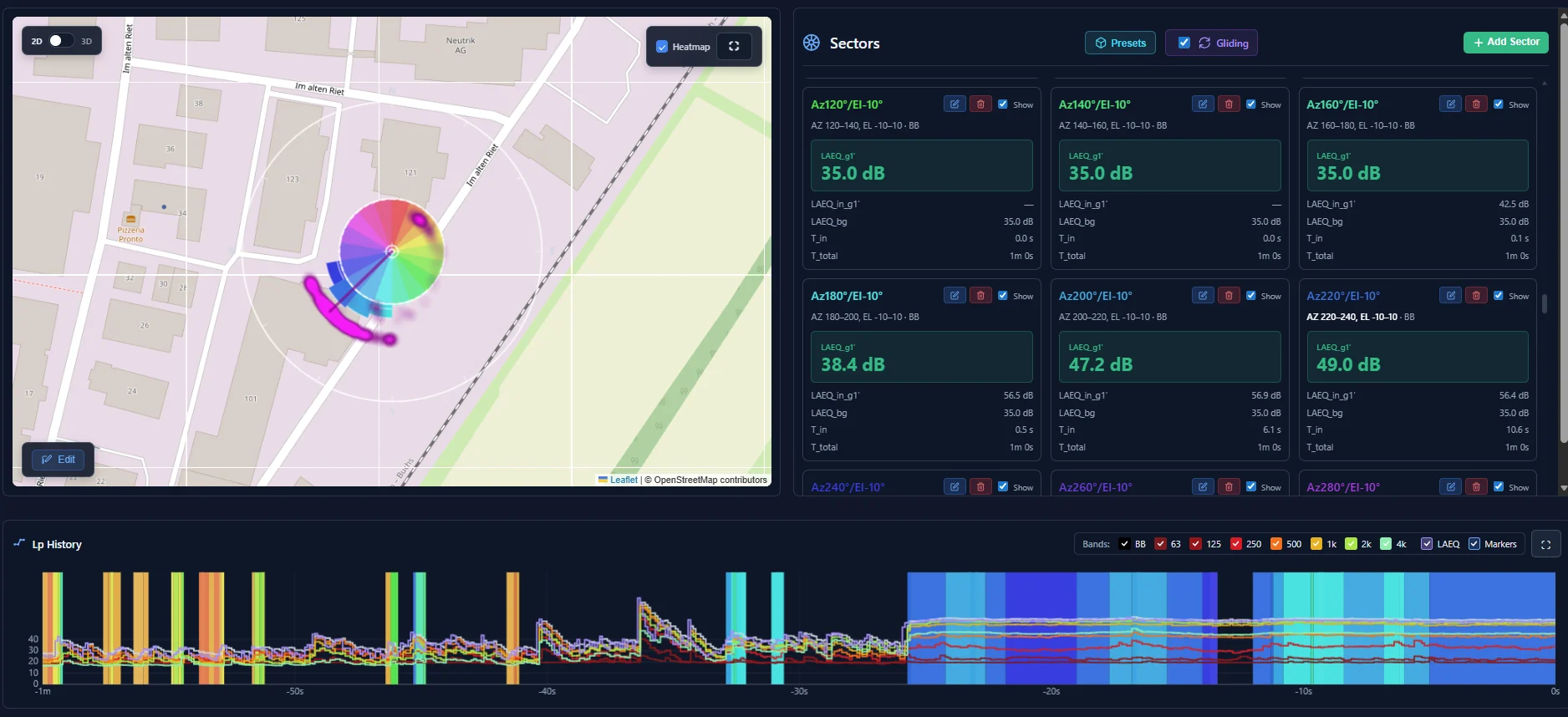
The NL1 Noise Locator is a 3D outdoor sound intensity sensor that adds directional intelligence where there is noise coming from more than one direction.
Conveniently attached directly below the measurement microphone, and connected to an XL3 Sound Level Meter, it identifies the Direction Of Arrival (DOA) of the dominant noise source.
This compact sensor provides noise directivity in environmental monitoring where you are concerned with noise from a defined direction.
Determine direction of dominant noise
Compact and outdoor-ready design
One-cable XL3 integration
Small footprint – NL1 is mounted under the microphone
Why NL1
Especially effective for low-frequency analysis
Synchronized logging of sound levels and direction
Reports horizontal and vertical Direction Of Arrival
(azimuth and elevation)
Use Cases
Typical Setup
The NL1 is mounted below an M2340 microphone enclosed in a WP40-90 weather protection case and bird spike.
Use cases include:
Environmental noise monitoring
Construction, road, aircraft and rail noise investigations
Industrial noise monitoring where there are multiple sources
Trustworthy Results
Real-world sound measurements are often affected by reflections and multiple sound sources. To help you judge the reliability of each result, every NL1 measurement includes a Pressure-Intensity Indicator (ΔPI).
ΔPI is a value that indicates by how much indirect sound (reflections) influences the measurement.
When the sound field is clean and well defined, ΔPI is close to zero and the result can be trusted. As reflections or additional sources increase, ΔPI rises, signalling reduced confidence.
ΔPI thus shows how trustworthy the sound direction result is. Lower values mean higher confidence, while higher values indicate that reflections or other sound sources may be influencing the measurement.
Only measurements that meet the ΔPI criterion are used for directional analysis. This allows automatic filtering and defensible, reliable results in post-processing.
How it Works
The NL1 uses eight microphones arranged in a compact 3D geometry. From these, 12 sound intensity probes are formed with a spacer of 2 cm, allowing A-weighted resolution in octave bands from 63 Hz to 4 kHz.
Sound intensity describes the direction of acoustic energy flow. By evaluating the resulting intensity vectors, the NL1 determines:
Azimuth (horizontal direction, referenced to North) and
Elevation (vertical angle, referenced to the horizontal)
Installation Guidance
Tips
For best results:
Avoid nearby reflective surfaces (recommended distance ≥ 5 m)
Install at sufficient height to reduce ground reflections
Position the sensor between relevant sources where possible
Live Values on the XL3 Screen
The NL1 connects directly to the XL3 Sound Level Meter via a single USB cable:
Power and data over one cable
Direction data synchronized with noise data logging
Real time data available via the XL3 Streaming API
Online Monitoring Software
MeasurEye – segment-based accumulation of noise by source direction
PC Reporting Software
Data Explorer – automatic marker generation based on directional segments
Based on sound intensity, rather than beamforming or pressure arrays
Outdoor design, high wind and weather resistance
The Pressure–Intensity Indicator (ΔPI) shows how reliable the sound direction result is by comparing sound pressure and sound intensity. A small value means the result is trustworthy, while a larger value indicates lower confidence.
As a research laboratory invested in supporting communities through real time noise monitoring, I am very happy to exclusively use NTi instruments. Not only are the robust, easy to use, and provide high quality data, the customer service is outstanding and their team will work with you to find the most cost effective and appropriate solutions needed for problems ranging from easy to difficult.
Erica D. Walker MSc, ScD, RGSS Assistant Professor of Epidemiology, Brown University School of Public Health
I’ve been using the XL2 for over 15 years for short-term and long-term measurements in all kinds of indoor and outdoor environments all across the country. The meter gets me what I want, when I need it. It’s not only the best value for acoustical measurements, it’s the best tool period. I bet my company and reputation on XL2 results and it has not let me down. You would be crazy not to consider adding NTi instruments to your toolkit.
Herb Singleton, P.E., INCE Bd. Cert., President, Cross-Spectrum Acoustics
We at Constructure GmbH use two XL3 sound level meters for noise monitoring during demolition work. We are very satisfied with these highly user-friendly instruments, the online monitoring in the MeasurEye Cloud, the good advice and qualified support. Factory calibrations at NTi Audio are also handled very smoothly and without complications.
To provide the best experiences, we use technologies like cookies to store and/or access device information. Consenting to these technologies will allow us to process data such as browsing behavior or unique IDs on this site. Not consenting or withdrawing consent, may adversely affect certain features and functions.
Functional
Always active
The technical storage or access is strictly necessary for the legitimate purpose of enabling the use of a specific service explicitly requested by the subscriber or user, or for the sole purpose of carrying out the transmission of a communication over an electronic communications network.
Preferences
The technical storage or access is necessary for the legitimate purpose of storing preferences that are not requested by the subscriber or user.
Statistics
The technical storage or access that is used exclusively for statistical purposes.The technical storage or access that is used exclusively for anonymous statistical purposes. Without a subpoena, voluntary compliance on the part of your Internet Service Provider, or additional records from a third party, information stored or retrieved for this purpose alone cannot usually be used to identify you.
Marketing
The technical storage or access is required to create user profiles to send advertising, or to track the user on a website or across several websites for similar marketing purposes.