
Building Acoustics

Professionals performing building acoustics measurements expect a system that supports an efficient workflow — especially when projects involve dozens or hundreds of tests.
A professional measurement system should:
- Reuse measurements instead of repeating them in the same room
- Allow the entire process to be completed by one person
- Identify issues before returning to the office
When it comes to large measurement campaigns, small workflow improvements can significantly reduce the time required on site.
NTi Audio solutions are designed to remove unnecessary time-wasting processes and simplify the entire workflow.
- Do not repeat measurements
- Operate instruments across multiple rooms
- Know the result before leaving the site
A Faster Measurement Workflow
With NTi Audio systems you can streamline the entire process:
- Take measurements in the order that suits you and the site
- Reuse RT60 and background noise measurements
- Operate multiple devices remotely and simultaneously in sending and receiving room
- See results instantly on the meter
The result: less repetition, fewer site visits, and faster project completion.


Measure in Any Order
Projects rarely follow the perfect sequence.
Sometimes background noise and reverberation time measurements must wait until the building is vacated.
NTi Audio solutions allow you to complete measurements whenever conditions allow, while keeping the entire project organized.

Stop Repeating Measurements
Many sound insulation tests share the same receiving room.
Instead of measuring background noise and RT60 repeatedly, simply reuse existing measurements.
This dramatically reduces measurement time on large projects.
Know the Result Before Leaving the Site
Instant analysis on the meter lets you verify compliance immediately.
If something is missing, you can correct it before leaving the building.
No surprises later at the office.

Sound Insulation DnT Result on the XL3

One Person Can Run the Entire Test
Operate multiple devices remotely in sending and receiving rooms.
This allows one technician to manage the entire measurement process.
Perfect for testing multiple rooms efficiently.

Designed for Large Measurement Campaigns
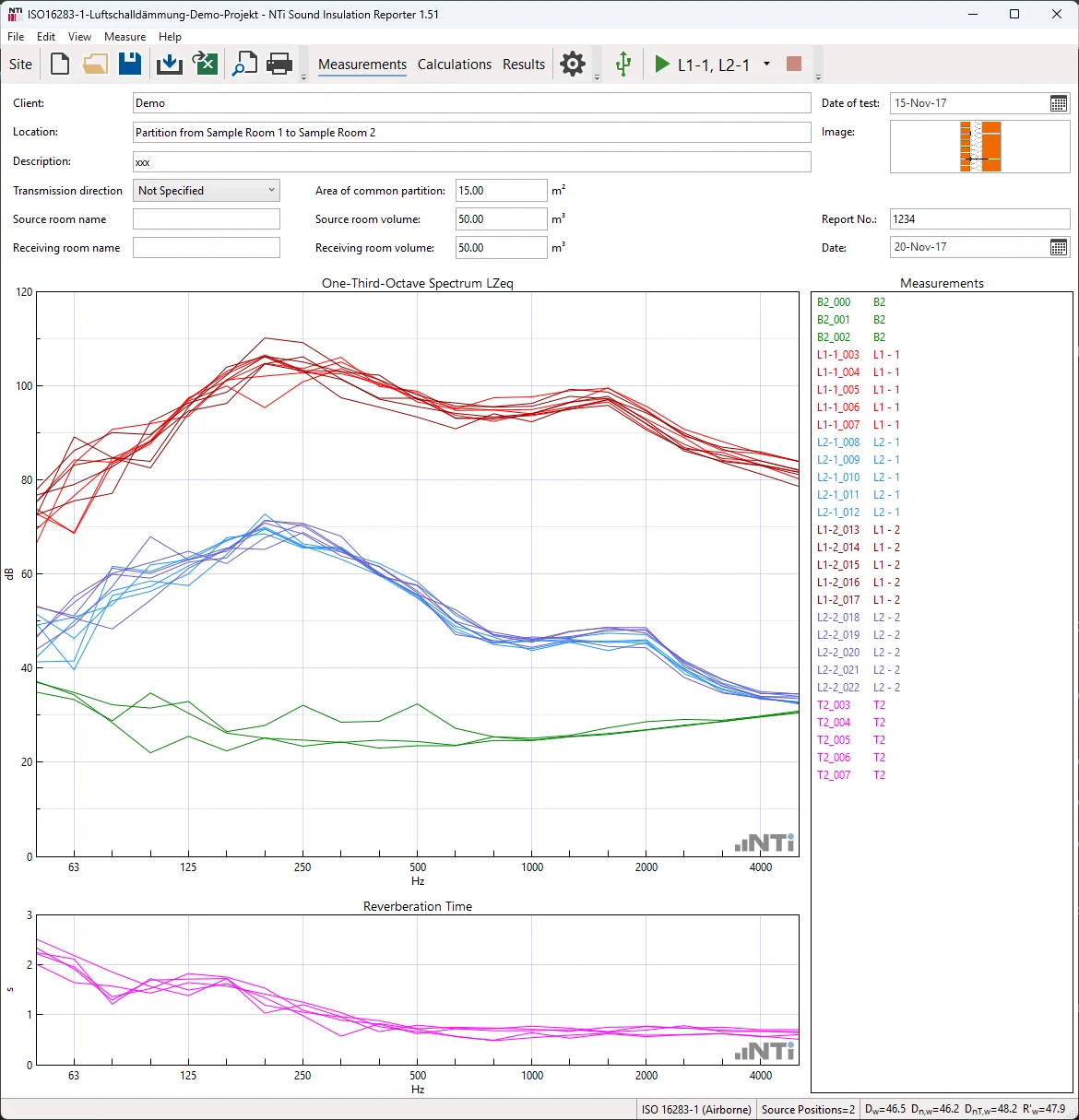
Back at the office, with your XL3 connected to your network (wifi or ethernet), the results are remotely available on your PC. With 2 clicks, the Sound Insulation Reporter automatically organizes all measurements.
Even projects with hundreds of tests remain easy to review and report.
Features include:
- Airborne, impact, and façade sound insulation results
- Clear project visualization of all measurements
- Customized standards-compliant reporting
Which instruments do you need?
XL3 Sound Level Meter
The XL3 Sound Level Meter is capable of measuring the required acoustic parameters in accordance with the standards. These are the sound levels in the sending and the receiving room, the background noise and the reverberation time, which quantifies the room effect.

DS3 Dodecahedron Speaker Kit
The DS3 Dodecahedron Speaker, as a sound source for airborne sound insulation measurements, together with the PA3 Power Amplifier, meets all the requirements of the ISO 16283 standard. In addition, we offer impressive performance data; with a weight of only 7.5 kg and a typical sound power of 120.5 dB, the DS3 is convenient to carry around on site. By pressing a button on the supplied wireless remote control, the test signal can be comfortably switched on and off from outside the sending room.

Reporting Software
Using a professional software package for controlling the process and reporting the results certainly simplifies the task. The measurement results obtained by the XL3 Sound Level Meter can be easily imported into the Sound Insulation Reporter. This PC software then calculates the required results for the airborne and impact sound insulation in accordance with the selected standards.

Optional devices you may need
Tapping Machine
The TM EOS2 Tapping Machine produces the impacts on the floor to determine the impact sound insulation. The hammers in this PTB-approved precision instrument hit the ground at a prescribed rate and with a constant, measured force. The remote-controlled TM EOS2 is compliant with the standards that define building acoustics.

Impact Ball
The IB01 Impact Ball is a lightweight, easy-to-use, and professional impact source for impact sound insulation measurements of floors and stairs, with an ideal performance for applications in wooden buildings, providing a highly accurate representation of human activities and low-frequency excitation.

Measure Faster. Report Faster.
Improve your building acoustics workflow with NTi Audio.
Standard Measurement Kit for Building Acoustics
- DS3 Dodecahedron Speaker
- Tripod for DS3 Dodecahedron Speaker
- PA3 Power Amplifier with built-in noise generator
- XL3 Acoustic Analyzer
- M2230 Measurement Microphone
- 1/2″ Windscreen 90 mm
- Class 1 Sound Calibrator
- XL3 Sound Insulation Bundle
Optional as required:
- TM EOS2 Tapping Machine
- IB01 Impact Ball
- Backpack for XL3
Standards
Building Acoustics measurements are defined by international and national standards.
- The optimized frequency response of the Dodecahedron Speaker Kit ensures precise measurements in accordance with the ISO 16283 standard.
- The Tapping Machine TM EOS2 is compliant to the standards ISO 10140, ISO 16283, ISO 717, DIN 52210, BS 5821, ASTM E 492 and SIA 181:2020
- The Sound Insulation Reporter software adheres to the standards ASTM E336, ASTM E413, ASTM E1007, ASTM E989, ASTM E966, ASTM E1332, BB93, DIN 4109, Document E, GB/T 19889, ISO 16283, ISO 140, ISO 717, ISO 10140, NEN 5077:2019, SIA 181:2006, SIA 181:2020.
- The solution offered by NTi Audio is compliant with the ISO 16283, ISO 140 and ASTM E336 standards.


Where to next?
Here you can dig deeper into each of the actual measurements:
Further links for Building Acoustics
Frequently Asked Questions
- Can I control the XL3 remotely and download data without stopping a measurement?
Yes. The XL3 includes an integrated web server and file server for browser based control via Wi Fi or LAN, and measurement data can be downloaded while the measurement continues. XL3 can also be remotely used to perform Building Acoustics measurement using Sound Insulation Reporter Software.
- Do the XL3 and XL2 support STIPA speech intelligibility testing?
Yes. With the STIPA Option installed, the XL3 or XL2 measure speech intelligibility according to IEC 60268-16:2020 (and also support older editions), including features like ambient noise correction and automated averaging.
Products used for Building Acoustics


News about Building Acoustics
- News & Updates•July 10, 2025
Introducing Smarter Sound Insulation Measurement with the New “Site View”
Read more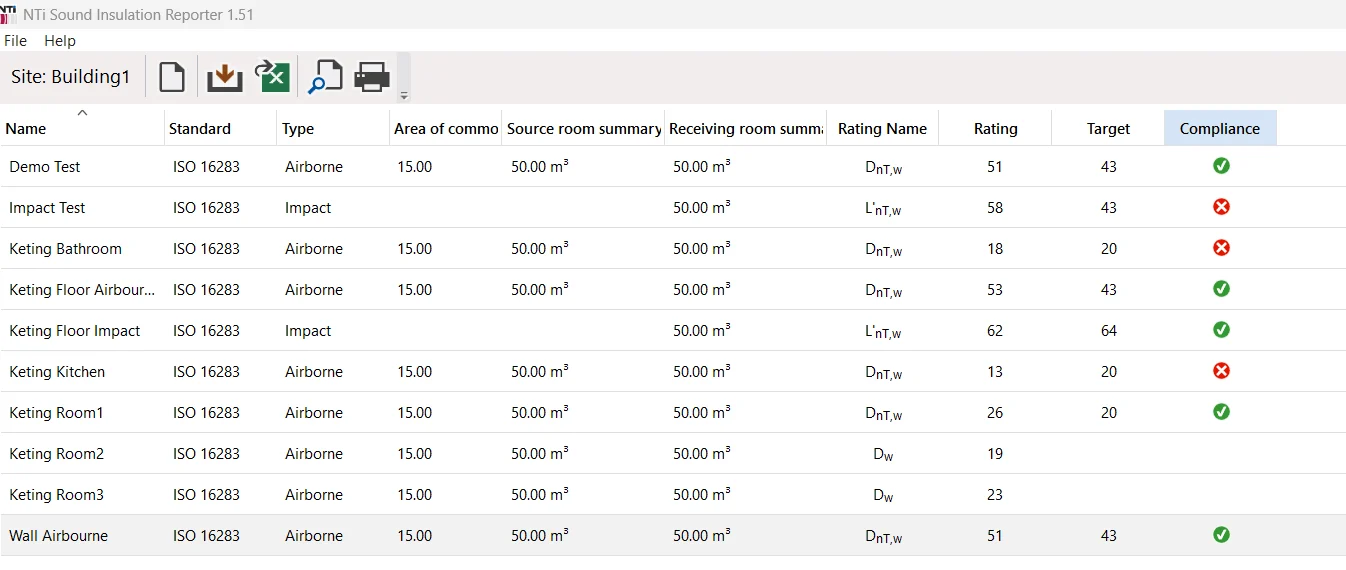


Downloads
- Application Notes
- Building Acoustics Solution
- DS3 Dodecahedron Speaker Kit
- Product Information
- TM EOS2 Tapping Machine
- Software


